Clean Out Your Pantry and Reset Your Health
Cleaning out and resetting your pantry is one of the easiest ways to build a strong foundation for healthy eating, clear out clutter, and set yourself up for daily cooking success.
Does Pantry Organization Matter?
It is easy for expired or rancid foods to get shoved to the back of the shelf, taking up valuable real estate. Clearing them out does more than just free up physical space.
The Power of Environment: Take a tip from Trader Joe’s and make your food easily visible. When healthy essentials are stocked and sitting right in the forefront, making balanced meal choices becomes more automatic and sustainable.
Build a Strong Foundation: An organized pantry allows you to easily take inventory of your stock and identify missing staple items. This makes planning and building balanced meals effortless.
Step-by-Step: How to Do a Pantry Audit
Ready to dive in? Block out a little time and follow these three simple steps:
Pull Everything Out: Empty your pantry completely so you can see every single item you own.
Clean the Surfaces: Vacuum up loose crumbs and wipe down the shelves. Pro tip: Spot-cleaning spills or leaks as soon as they happen is your best defense against pests.
Inspect and Rotate: Check expiration dates. Toss what is past its prime and move items that will expire first to the front. In restaurant terms, this type of organization is called first in, first out or FIFO.
What to Toss and Why
As you go through your items, keep an eye out for:
Expired Items: Throw away any expired products, even if they are completely unopened.
Rancid Oils, Nuts, and Nut Butters: If it smells or tastes "off," toss it - even if the date on the container says it should be okay. FYFL tip: For those high fat ingredients that you use less often, store them in the freezer to extend shelf life!
Compromised Canned Goods: Throw out any leaking, bulging, or rusting cans.
Signs of Pests: Inspect open bags of bulk grains or flours for webbing or clumping, which indicates pests. To prevent bugs, we recommend transferring your flours and grains into airtight glass containers. FYFL tip: Storing these items in the freezer can help to ward off weevils, especially helpful for those of us in hot and humid climates!
Flat Baking Ingredients: Check baking items and spices. Leavening agents like baking soda or baking powder might not smell bad when they age, but they lose their potency. If they are expired, your baked goods won't rise properly.
Stale popcorn and chips: This one is a no-brainer. Half eaten bags of chips or popcorn that have not been closed properly are eating up valuable real estate.
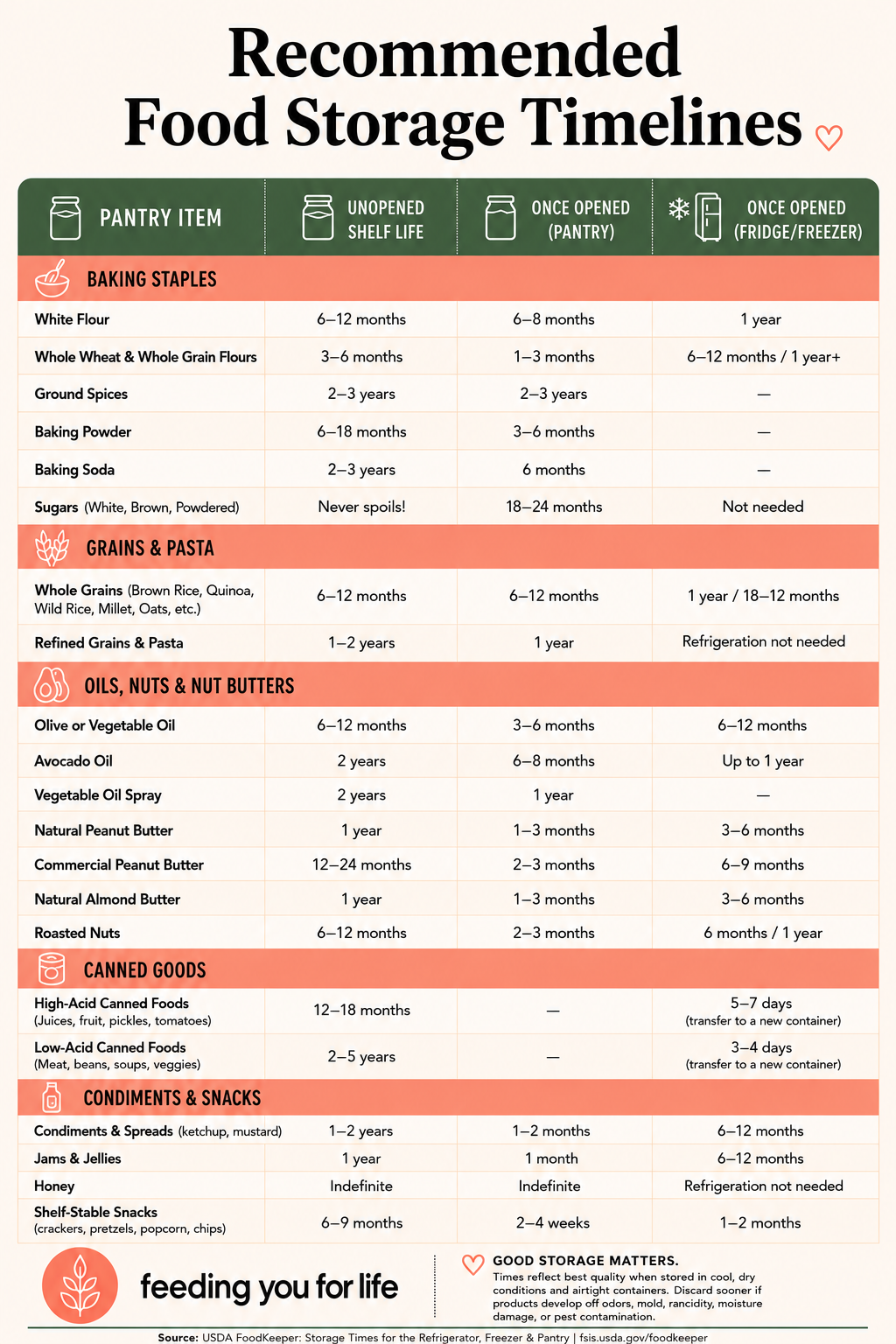
The Cheat Sheet: Storage Lifespans & Expiration Guide
The USDA Food Safety and Inspection Services recommends checking your pantry every few weeks, but that isn't realistic or sustainable for most of us. Instead, try to do a deep audit every six months. You could even align this with the season and shifting cooking habits (e.g., going into spring/summer or into fall/winter).
Many opened pantry staples (like nut flours and specific oils) have a shelf life of about 6 months, so this frequency can help keep you on top of food safety and freshness without feeling overwhelmed. Writing a purchase date or an opened date in black sharpie on these items can help with your pantry management.
Use this quick reference guide of common pantry staples with storage times adapted from the USDA’s FoodKeeper app:
Practical Ways to Keep it Clean Between Audits
Try these quick tips to keep your pantry functional (and cleaner) between deep-clean sessions:
Spot Clean Immediately: Wipe up leaks or spills the moment you see them.
Check as You Go: Look at expiration dates as you grab items to cook, and throw out anything that has expired.
Practice FIFO: When returning from grocery shopping, tuck new items to the back and pull older items to the front.
The Sharpie Hack: Keep a permanent marker in your kitchen drawer. Write the date you opened an item directly on the packaging (especially helpful for items you use multiple times like baking goods, condiments, oils, and nuts). This makes it much easier to see how long an item has been opened and when it’s time to toss it.
Use Tech: Download the USDA's FoodKeeper app (Apple or Android/Google Play) to quickly look up safe storage times and freshness recommendations.
What to Keep On Hand: Our Recommended Staples
Once you've cleared out the pantry, it’s time to fill the space with essentials that build the foundation for healthy meals. Our team put together a quick list of what we keep stocked in our own pantries:
Wholesome Grains: High fiber grains, whole grain pasta, oats.
Ready-to-Eat Foods: Organic prepared beans/legumes, tinned fish, pre-cooked rice/grain packets.
Flavor Boosters & Vinegars: Vinegars (apple cider, balsamic), chicken stock/bone broth, tomato sauce, curry paste.
Healthy Fats & Crunchy Snacks: Pumpkin seeds, dry-roasted nuts (pistachios, almonds), natural peanut or almond butter, tahini, dried fruit, and seaweed wrappers. Note: Store your pumpkin seeds and nuts in the freezer to keep them fresh longer!
Cooking Oils: Avocado oil and avocado oil spray for high-heat cooking; extra virgin olive oil for dressings and finishing.
If you haven’t cleaned out your pantry in ... well, ever, don’t stress! Use today as your jumping-off point. Once you complete your first audit, set a calendar reminder for 3 to 6 months from now, to help make it a habit!
Sources
Dai, J., Cone, J., & Moher, J. (2020). Perceptual salience influences food choices independently of health and taste preferences. Cognitive Research: Principles and Implications, 5(1).https://doi.org/10.1186/s41235-019-0203-2 Cited by: 54
Ensaff, H., Homer, M., Sahota, P., Braybrook, D., Coan, S., & McLeod, H. (2015). Food choice architecture: An intervention in a secondary school and its impact on students’ plant-based food choices. Appetite, 95, 230–237.https://doi.org/10.1016/j.appet.2015.07.014
USDA https://www.foodsafety.gov/keep-food-safe/foodkeeper-app
